
Though Years May Pass
Updated From the Archives

In 2021, we were delighted by the Mexican posters on display at Alley Cat Books in the Mission, San Francisco. They featured a contemporary iteration of Mexican muralist style dedicated to social justice themes. The book seller rolled ours into a cardboard tube for safe travel. The artist is a friend of his, has a studio in Mexico City.
As a literary translator, I approve of the permeability of borders. Artists have always found their way past borders more readily than most. The poster we bought was for Oaxaca: our visits there in the 90s shimmer in memory. Oaxaca: home of perennial rebellion. The poster has one sentence:
Así pasen años, hay barricadas que no se apagan, las que arden con el corazón.
The statement stirred me. Standing in the bookstore, I was frustrated, because no adequate translation came to mind. The verb apagar means to put out, extinguish, (apaga la luz/turn out the light) silence, soften, placate, (tiempo apaga los rencores/time soothes bad feelings) and much more. Reflexive, as it is here, apagarse: to go out, fade, finish, die, dim, end, vanish. Barricades that cannot have such an action done to them, or cannot do it to themselves.
Small common words are also often difficult, their translation dependent on context. But then, translation, like much of life, always depends on context. Restaurant menus teach us that con means “with,” as in con queso. Not so here. Sueño contigo means “I dream of you,” for example. I arrived at these two, not happy with either:
Though years go by, there are torched barricades that don’t go out—those aflame in the heart.
Though years pass, there are barricades that can’t be taken down: those that burn in the heart.
I sent them to Agustín Cadena, a Mexican writer I translated, who answered me, as he often does, in Spanish and English:
Me gusta más la segunda opción: "barricades that can’t be taken down". Maybe all options are imprecise, but the original Spanish is imprecise too. Anyway, I think "barricades that can’t be taken down" is closer to the political implications of it: "taken down" means by someone, whether government, police, silence, or time.
I also sent the drafts to two excellent Spanish-to-English translator associates. Literary translators live for this sort of problem. Jill Gibian suggested, “for ‘Así pasen años’ you might want ‘may pass’ to highlight the use of the subjunctive.”
Of course I do, Jill. Gracias! This is why writers of any kind need close readers: you may proof it a dozen times and still miss the obvious oversight.
Amanda Powell wrote: “Barricades traditionally get built (tossed together) in the streets, then set ablaze (right, Jacobin sisters?) I can’t be the only old Re-Vo-Lulu here.”
She reminded us of Seattle, 1968; the WTO, 1999. I flashed on my own forays into the streets. Sacramento, 1967: massive march in protest of Governor Reagan, the Vietnam war, in support of the farmworkers’ grape boycott. The attempt that year to unionize social workers led to my one arrest, a badge of honor I pull out to polish now and then.
I’m a grandmother activist reactivated: demonstrated in May and most recently, in the June 14, 2025 No King’s march.
“I’m also thinking about that graceful phrase, las que arden *con* el corazón,” Amanda added, suggesting:
Though years may pass, some barricades are still burning /still burn—those the heart sets ablaze.
Amanda’s email ended: ¡A las barricadas! ¡No pasarán!!
Agustín’s concluded: “¡Hasta la victoria!”
As I said, for old radicals at least, the sentence is stirring.
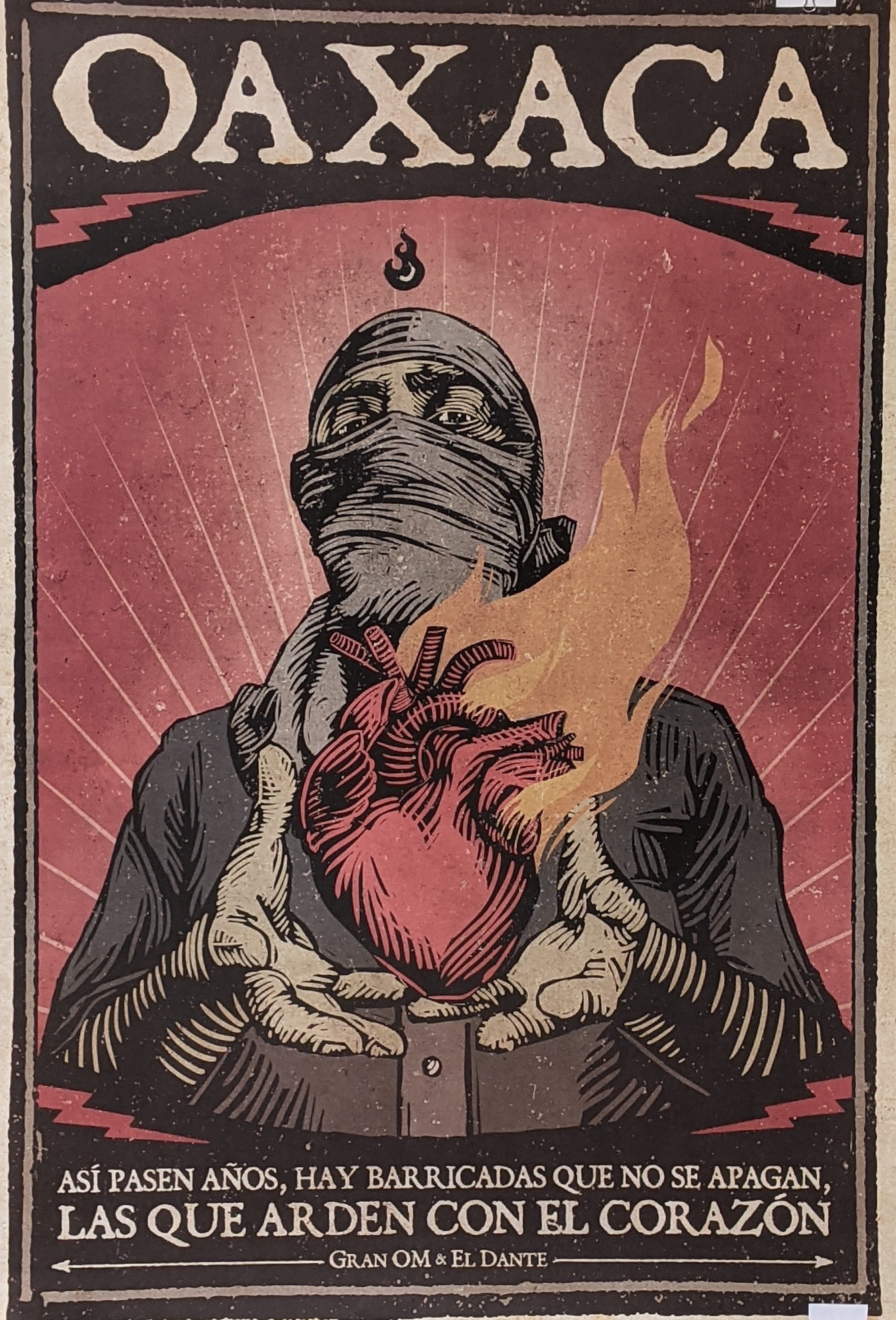
What demolishes barricades? How often does passion fade and account for more defeats than whoever or whatever is being opposed? As Agustín said, time also dims those flames. The sentence is hopeful, believes some passions never die. Freedom and civil rights are eternal flames within us, aren’t they?
We bought that poster in July. In September, I showed the options to Phil, my husband and alpha reader. By then I had:
Although years may pass, some barricades cannot be doused—those that flame in the heart.
I didn’t like doused. Phil doesn’t know Spanish. His English is what I need. He made excellent suggestions, as usual. Now I have this, because of Phil and Amanda and Jill and Agustín and because I’m a sucker for alliteration:
Though years may pass, some barricades yet burn—those ablaze in the heart.
This too may change. The mood of life is subjunctive. Such is the fluidity of translation. Like any worthy writing, it’s never done.
But know this: the spirit of this poster is what fuels us now.
¡No nos moverán! We shall not be moved!
Gran Om is alive and crusading in Mexico City.
https://granom.com.mx/
It was so enjoyable to follow your semantic pilgrimage as a translator trying to capture the galvanizing power of an apparently simple phrase on a poster in Spanish into English. As a translator myself, I agree with what you describe as "the fluidity of translation." I do believe that translation is an art form as it seeks to recreate the context of an original text. Translators are deeply concerned with the ramifications of words that can best capture the spirit of that text. I like your last option: it gets to the universal flame in the heart that fuels the fight for justice and freedom. It is alive and well today as we fight to restore sanity in a world driven by chaos.
I do enjoy your posts, Patricia!
Here are thoughts I had as I read about the translation journey that brought you to: Though years may pass, some barricades yet burn—those ablaze in the heart.
I felt the barricade around the heart of the oppressed. The battle may be over and lost, still simmering, but this barricade protects my heart and the heart of my people and ancestors, you can never pass this barricade. Take our land, our language, our customs but we have protected our hearts, our collective heart.