
For the Painters
CHAC memoir, 1982

In memory of Carlos Martinez and Stevon Lucero
The artists discuss ways to make one mat appear to be three, using a straight edge, a steady hand and the easily fooled average eye.
“Saves money and looks expensive at the same time,” Tortuga explains.
“Wow,” says Carlos, the chief target of this demonstration.
Tortuga was dismayed by the tacky framing Carlos put on his paintings. Carlos Martinez, that is, Chicano Humanities and Arts Council (CHAC) director, also an artist. CHAC’s first director was Carlos Santistevan. Another painter/muralist mentioned below is Carlos Sandoval. Carlos Fresquez, a fine painter, was sometimes around but does not appear here. Too many Carlitos.
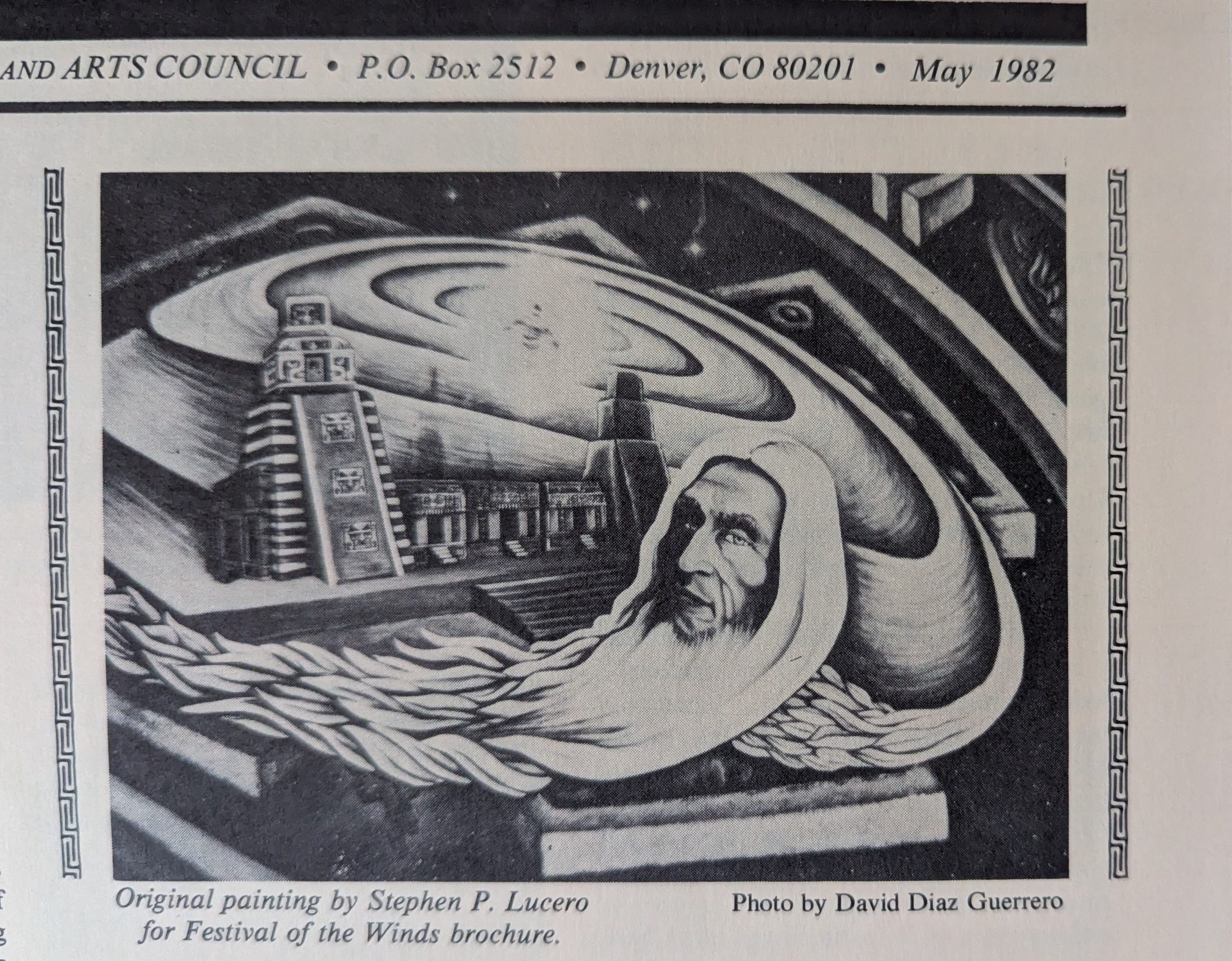
The artists seldom discuss Ernie’s impressionism or Stevon’s Metarealism, Steve’s label for what he does. His work is symbolic, surreal, Daliesque. Steve’s more than happy to elaborate on it, at length, if you inquire. But the painters are more likely to ask, “Where’d you get those canvases? Wow, that’s a great price,” followed by a discussion of the pros and cons of stretching your own canvases.
I remind them of what Picasso said: when critics gather, they discuss theories and movements; when artists meet, they talk about where to buy the best turpentine. In Picasso’s time, everyone painted with oils. Turpentine was essential.
For a few years, CHAC rented the spacious upstairs of a tall Victorian house. We turned four rooms into low-rent studios, so painters were there daily. The Steelworkers Union owned the building, had offices on the first floor. The place hadn’t been thoroughly cleaned, let along painted, in decades. The union’s conference room wall featured a huge photo of LBJ.
“He’s the last president we liked,” one of them growled.
Ernie holds up his latest pastel, a chiaroscuro exercise—strong light from one source, dramatic dark on the shaded side. The painters pour fresh coffee, light cigarettes, examine the play of light and shadow from several distances.
When Ernie showed his work to Ramon Kelley, Ramon said, “yes, you could be an artist. First you must quit your job. Second, you must paint and paint and paint.” Ernie did both.
“Are you a painter?” Carlota asks me.
“No, a poet.”
“Same thing,” she shrugs. “One of God’s children.” A bit of amusement in her luminous eyes.
“You know what Michelangelo said,” Ernie offers. “A painting is a visual poem.”
Carlota created 20-foot murals years before the California mural movement began, paints backgrounds for museum dioramas, makes a living with her art.
We load paintings into the trunks and backseats of our cars, take them to the gallery, hang the show, try for a fair distribution. Nevertheless, at least one artist complains about where we hung his work.
“You know why?” Carlos Martinez snaps. “We don’t like you.”
At the opening, a Chicano lawyer bought one of everybody’s and the painters promptly got drunk.
“Wow,” Ernie says, “he didn’t have to do that. Jeez, that was great.”
“Maybe,” I say, “he liked the work. Maybe he bought it because it was good.”
Ernie blinks, pondering this novel concept from his wine high.
The work they do—they’re used to getting nothing for it. Day after day from Christmas to New Year’s, while all the world idles or shifts to party mode, Jerry chips at his block of stone in his CHAC studio, squinting into the taskmaster of his vision.
“I’m trying to see what it wants to be,” he muses.
Steve paints in his Metastudio on the Northside. Monday to Friday, Tortuga reports to his CHAC studio, down the hall from Jerry’s. By nine. And stays til five. It is a crazy job, performed entirely on speculation.
Fred Sanchez slaps a hand across a magazine page. “Look at this,” he snorts. “They call artists the voluntary poor. Shit. I never volunteered.”
Jerry is past thirty now, promised his art he would not marry or seek a steady job until after thirty. Besides sculpture, he does wall-sized murals, his body at one with the giant, rhythmical strokes of the spray gun. He looks married already. They all do when bonded with their work.
Someone says Stevon Lucero’s work repeats the same somber face, over and over. Yes, and Carlos Sandoval’s same dreamy face entangled in mystical webs of root and vine and Carlota’s same woman’s face with large luminous eyes and Tortuga’s same brilliantly colored compositions of adobe walls and dusty plazas. If they are seekers worthy of the name, they’ll go on repeating and evolving until they get it right, until the need is sated, until heartache is worked out and love worked in.
***
I was CHAC’s grant writer 1981 - 1985, during which time I wrote the first draft of this essay. Sara FD recently helped workshop it to this point. In 1985, I left CHAC, had to get a job that paid a real salary. After the Steelworkers sold the Victorian on 17th and Downing, it became an expensive spa. In 1982, Reagan was president. The Steelworkers hated him. In 1982, Carlota EspinoZa was the only woman among Denver’s Chicano muralists. In 1982, Ramon Kelley was a successful painter, generous with mentoring young artists. No one calls Tony Ortega “Tortuga” these days. Anyway, in 1982, that was mainly me. Now Tony’s paintings are full of people and he’s one of several from those days who have made a living at it. Some are gone. This piece is dedicated to two of them.
G-Ma P ❤️
You never stop amazing me. Every time I learn something new about you, I sit back and think… “Wow, my grandmother is seriously one of the coolest women ever.”
A civil rights activist.
A poet (This I knew)
A creative soul surrounded by legendary artists and history.
Who knew you carried so many stories, gifts, and experiences with such grace?
Reading your words today gave me a whole new appreciation for the life you’ve lived and the impact you’ve made on people around you. Your talent, wisdom, courage, and heart shine through every line.
You are timeless, G-Ma P.
As Snoop would say… you are the “Sniz-itz” 😎
Love you so much and I’m proud to call you, my grandmother.
Wonderful! Thanks so much, Pat. I would love to see the painting by Stephen Lucero for the Festival of Winds brochure. The festival name and the painting as well as the closeness of painting and poetry reminded me of a poem from "A Year with Rumi" by Coleman Barks:
Crying out loud and weeping are great resources.
A nursing mother, all she does
is wait to hear her child.
Just a little beginning-whimper
and she's there.
Cry out. Do not be stolid and silent
with your pain. Lament,
and let the mild of loving flow into you.
The hard rain and the wind
are ways the cloud has
to take care of us.